- Welcome to FJowners.com.


News:
Welcome to FJowners.com
It is the members who make this best place for FJ related content on the internet.
Recent posts
#11
Modifications / Fj1100 top triple
Last post by Indiana jones - Yesterday at 09:53:14 AMAny recommendations for a top triple clamp to convert to regular bars on an Fj1100? Any other bike with the same measurements or a good aftermarket option.
#12
General Discussion / Re: What the hell is wrong wit...
Last post by giantkiller - May 15, 2026, 01:13:52 PMThis thing would completely flip over if you throttle a little too aggressively in first just comming on the power. I almost used the racoon scraper the first time I gave it the gas in 1st. If you turn off the abs/traction control it will come up as far as you want in 3rd gear as it hits the power. Woohoo. It's insanity.
#13
General Discussion / Re: What the hell is wrong wit...
Last post by giantkiller - May 15, 2026, 01:01:33 PMI test rode a 2024 Carbon R. With 17s. It handles like there's no weight there. It had 700 miles. While I was riding it. I was like I'm gonna buy this. But the dealer would not budge at all. Wouldn't take off the bogus $300 service charge on a 700mi bike. Wouldn't even sell me a carbon seat cowel at dealer cost. Wouldn't cost them anything. So I walked out. The dealership with the Champions edition was 20mi from my house but I didn't want the bigger tires. It handles like my fj1350r with inverted gixxer front end Honda shock and gixxer wheels. Instead of how awesome the FTR with 17s handles. But when I found out that the 17 inch wheels were $805 for both. And they come with bearings and seals even have 90° stems already installed. You could just transfer everything else from the big wheels. But I ordered everything else. Then I could put the big wheels back on. Add a belly pan and go adventure bike riding.
#14
General Discussion / Re: What the hell is wrong wit...
Last post by giantkiller - May 15, 2026, 12:16:38 PMWell I'm retarded. 
I just picked up a 2022 FTR 1200 Champions edition.(only 400 made only in 2022). 500mi on it $10,000 off original price. Has a plaque on the tank of the 5 years straight that Indian won flat track championships up to the year that it was made.I think they won more until HD had them regulated out.
Anyway. It has 19" front wheel and 18" rear. Like the original flat track racers. 2022 and up FTRs went to 17s front and rear. Except for champions and track version.
It has Ohlins suspension front and rear. The Carbon R version s also get Ohlins suspension. But mine came with longer travel to better match the racers. Mine also has more carbon fiber than the Carbon Rs. It's too tall for my 30" inseam. I can do it but... I ordered 17" wheels and everything else to convert it to 17s. Including road 6s. 190/55/17 and 120/70/17.
Besides being all carbon fiber, and Ohlins. They have stainless braided brake lines. Brembo calipers front and rear. It has rearsets. Full abs/traction control. 3 settings rain, standard, and sport mode. Has a digital dash. Cruise control. GPS that displays in the background of the guages. USB port. And all kinds of other stuff I'll never use. Engine cases are magnesium. It makes 87ftlbs of v-twin torque. Pipe and tune will get it to 104ftlbs. Hank Scott dynoed my 1350r at 114ftlbs. But this thing feels like way more (thus my obsession). It weighs 518lbs wet. All the naked bike guy's are saying thats heavy. So of course I'm going to lighten it up. Aftermarket exhaust-22lbs. I'm going to remove passenger pegs and brakets. And the racoon scraper licence plate braket mounted on the swingarm
And a lithium battery.
I just picked up a 2022 FTR 1200 Champions edition.(only 400 made only in 2022). 500mi on it $10,000 off original price. Has a plaque on the tank of the 5 years straight that Indian won flat track championships up to the year that it was made.I think they won more until HD had them regulated out.
Anyway. It has 19" front wheel and 18" rear. Like the original flat track racers. 2022 and up FTRs went to 17s front and rear. Except for champions and track version.
It has Ohlins suspension front and rear. The Carbon R version s also get Ohlins suspension. But mine came with longer travel to better match the racers. Mine also has more carbon fiber than the Carbon Rs. It's too tall for my 30" inseam. I can do it but... I ordered 17" wheels and everything else to convert it to 17s. Including road 6s. 190/55/17 and 120/70/17.
Besides being all carbon fiber, and Ohlins. They have stainless braided brake lines. Brembo calipers front and rear. It has rearsets. Full abs/traction control. 3 settings rain, standard, and sport mode. Has a digital dash. Cruise control. GPS that displays in the background of the guages. USB port. And all kinds of other stuff I'll never use. Engine cases are magnesium. It makes 87ftlbs of v-twin torque. Pipe and tune will get it to 104ftlbs. Hank Scott dynoed my 1350r at 114ftlbs. But this thing feels like way more (thus my obsession). It weighs 518lbs wet. All the naked bike guy's are saying thats heavy. So of course I'm going to lighten it up. Aftermarket exhaust-22lbs. I'm going to remove passenger pegs and brakets. And the racoon scraper licence plate braket mounted on the swingarm
And a lithium battery.
#15
General Discussion / Re: Flying Thread
Last post by Waiex191 - May 15, 2026, 08:24:46 AMQuote from: T Legg on May 14, 2026, 06:15:14 PMThat engine sounds nice as your plane flys by. Its hard to believe its a 1600 Volkswagen . How high can it fly with that engone ?Thanks! It's a 2180 VW. Nominally rated at 80HP. I've bumped the compression from 8:1 to 9:1, replaced the stock 1.1:1 rockers with 1.25:1, and made some improvements to the induction system. Before all these mods, while I was in phase 1, I could get no higher than 9000'. I've not gone back to check my ceiling again but I suspect it's higher. Last year we were flying home from Red Wing, and climbed from about 800' to 7500' averaging 500fpm. We are cruising about 120kts.
#16
Modifications / Re: 180/55R tire onto YZF600R ...
Last post by giantkiller - May 15, 2026, 12:17:21 AMQuote from: jvb_ca on May 03, 2026, 02:38:34 PMI just bought road 6s for my new FTR 190/55/17.Quote from: Pat Conlon on May 02, 2026, 09:40:38 PMYou can't find a 170/60-17 Michelin Pilot Road 5?Only Michelin Road 6 is available in 170. And its close to $300 and not crazy about its tread pattern.
I can get the road 4 or 5 for 50 60$ less in 180 and I like their tread patterns. Only other Michelin option is the pilot power 2ct, which isn't a bad tire. I run it on front.
#17
Modifications / Re: 180/55R tire onto YZF600R ...
Last post by giantkiller - May 15, 2026, 12:13:57 AMI run 190s on my fjs with gsxr600 wheel. But to get the 600 wheels to work I used Honda counter shaft sprockets that are slightly offset. I don't remember which Honda they are off. But had to have them machined in the middle to get the nut to clear. I know 180s fit no problem.
#18
Yamaha FJ1100 / FJ1200 Running Problems / Re: 84 FJ1100 slight miss from...
Last post by Pat Conlon - May 14, 2026, 10:13:59 PMThanks for the update! Problem solved 
#19
Yamaha FJ1100 / FJ1200 Running Problems / Re: 84 FJ1100 slight miss from...
Last post by indyblue - May 14, 2026, 08:19:46 PMOld topic I know, but I have new info.
One day it began to make terrible noises like my timing chain jumped and then it died. It turned over but no spark. Here's what I found. The pickup base plate srews backed out and the baseplate was lose and moving timing. It eventually got so lose that it ate the pickups.
New (used) pickups and some locktite on the baseplate screws and she runs beautifully now.
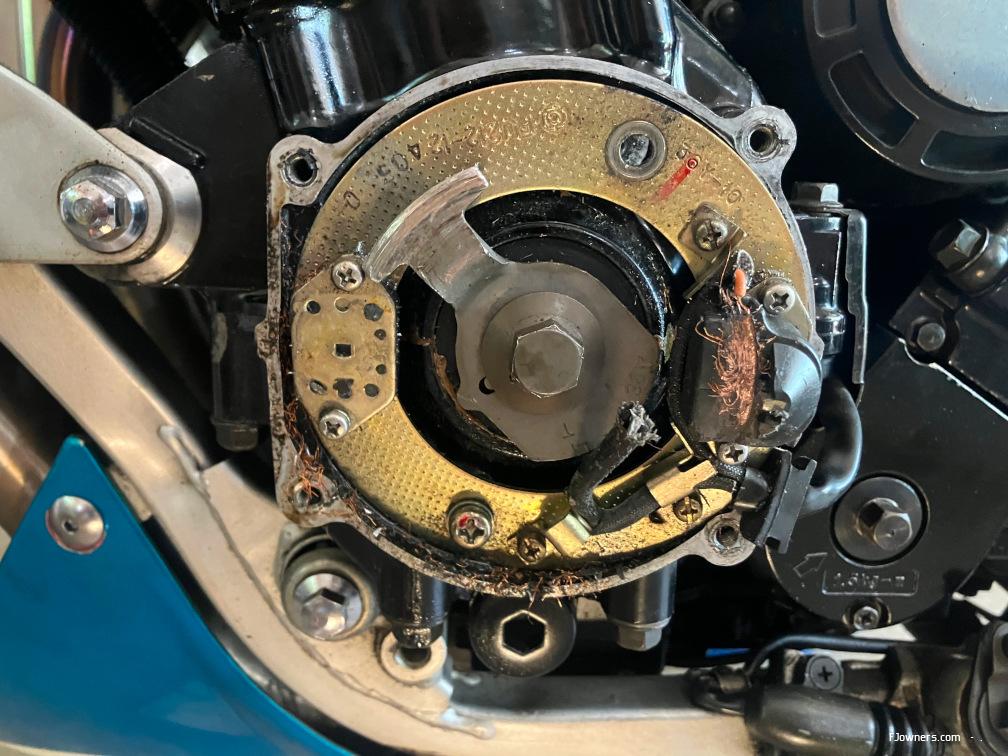
One day it began to make terrible noises like my timing chain jumped and then it died. It turned over but no spark. Here's what I found. The pickup base plate srews backed out and the baseplate was lose and moving timing. It eventually got so lose that it ate the pickups.
New (used) pickups and some locktite on the baseplate screws and she runs beautifully now.
#20
General Discussion / Re: Flying Thread
Last post by T Legg - May 14, 2026, 06:15:14 PMThat engine sounds nice as your plane flys by. Its hard to believe its a 1600 Volkswagen . How high can it fly with that engone ?